
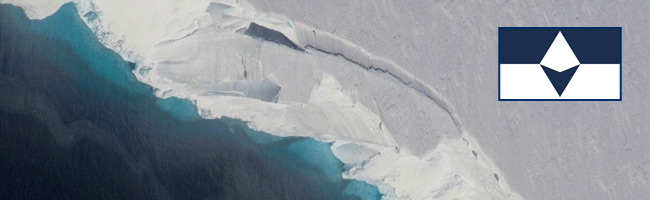
Now that a huge crack has formed in Antarctica's massive Thwaites Glacier, life on earth may experience a little short on breath.
Glaciers are suspected to be reducing oxygen levels for approximately 1.5 million years. "We know atmospheric oxygen levels began declining slightly in the late Pleistocene, and it looks like glaciers might have something to do with that," said Rice University's Yuzhen Yan, corresponding author of the geochemistry study published in Science Advances. "Glaciation became more expansive and more intense about the same time, and the simple fact that there is glacial grinding increases weathering."
Weathering referes to physio-chemical processes that break down rocks and minerals. The observance of oxidation of metals is of the most important studies in relation to environmental changes. The rusting of iron is an example; red iron oxide froms quickly on exposed surfaces to amtospheric oxygen, O2.
According to Dr. Yan, constant grinding movement of glaciers expose fresh crystalline surfaces from sedimnetary reservoirs to atmospheric oxygen, resulting in weathering that consumes oxygen. Glaciers can also promote oxygen consumption by exposing organic carbon that had been buried for millions of years.
In 2016, Dr. Yan, Michael Bender and John Higgins, Princeton University, analyzed bubbles in ice cores revealing O2 increases after the length of Earth's glacial cycles more than doubled around 1 million years ago.
Earth's current ice age began approximately 2.7 million years ago with dozens of glacial cycles following since it's beginning. Ice caps would engulf the earth and retreat to the poles. Each cycle lasted around 40K years until about 1 million years ago. Roughly at the same time frame that atmospheric oxygen began to decline, glacial cycles began lasting as long as 100,000 years. The glacier formations causes an absorption of O2, creating a "sink", consuming atmospheric oxygen on a global scale.
In recent studies of older ice cores, Dr. Yan, Higgins and colleagues from Oregon State University, the University of Maine and the University of California, San Diego, have discovered heavy declines of atmospheric oxygen levels in glacial cycles since 800,000 years ago. Dr. Yan and his associates made some calculations for an indication of how much oxygen was consumed and found only accounted for about a quarter of the observed decrease. Determination of the extent of Earth's ice coverage isn't precisely known, leaving a wide range of uncertainty about the magnitude of chemical weathering from glacial erosion. Antarctica's massive Thwaites Glacier cracking and falling into the sea may reveal more details to oxygen level changes in our atmosphere.
Sources:
https://www.sciencedaily.com/releases/2021/12/211220190643.htm
https://www.natureworldnews.com/articles/48641/20211221/air-bubbles-preserved-in-antarctic-ice-highlights-the-possible-cause-of-low-oxygen-level.htm
https://www.independent.co.uk/climate-change/news/glaciers-oxygen-ice-age-melting-b1980188.html
https://www.ecowatch.com/doomsday-glacier-antarctica-crack-2647666896.html
https://www.nationalgeographic.com/environment/article/exclusive-first-pictures-of-iceberg-three-times-the-size-of-manhattan
Thwaites Glacier image courtesy of Jeremy Harbeck/OIB/NASA
